
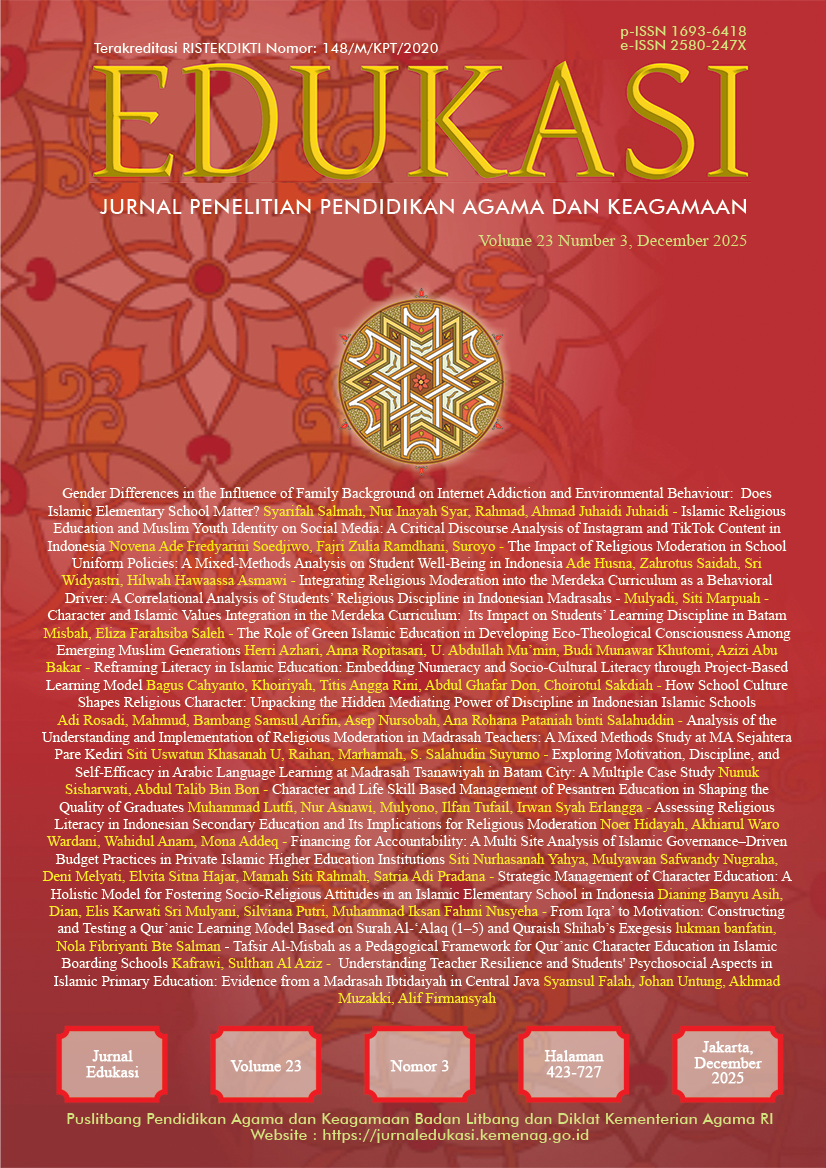
How School Culture Shapes Religious Character: Unpacking the Hidden Mediating Power of Discipline in Indonesian Islamic Schools
DOI:
https://doi.org/10.32729/edukasi.v23i3.2388Keywords:
School culture, religious character, discipline, mediating effect, Islamic junior high schoolAbstract
ABSTRACT
This study investigates how student discipline mediates the relationship between school culture and the development of religious character in Indonesian Islamic junior high schools. Although prior research has established correlations among these variables, the specific mechanism through which school culture shapes religious character remains insufficiently explained. This study addresses this gap by testing discipline as a behavioral pathway that translates cultural values into consistent moral actions. A quantitative cross-sectional design was employed using survey data from 268 students across three private Islamic junior high schools. The analysis used Partial Least Squares Structural Equation Modeling (PLS-SEM) to assess both measurement and structural models, including mediation effects. The results show that school culture significantly predicts student discipline and religious character. Discipline also has a strong direct effect on religious character. Mediation analysis indicates that discipline ac
ABSTRAK
Penelitian ini mengkaji bagaimana disiplin siswa memediasi hubungan antara budaya sekolah dan pengembangan karakter religius di sekolah menengah pertama Islam di Indonesia. Meskipun penelitian sebelumnya telah menunjukkan adanya korelasi di antara variabel-variabel tersebut, mekanisme spesifik yang menjelaskan bagaimana budaya sekolah membentuk karakter religius masih belum terjelaskan secara memadai. Studi ini mengisi kesenjangan tersebut dengan menguji disiplin sebagai jalur perilaku yang menerjemahkan nilai-nilai budaya menjadi tindakan moral yang konsisten. Desain penelitian kuantitatif dengan pendekatan potong lintang digunakan dengan memanfaatkan data survei dari 268 siswa di tiga sekolah menengah pertama Islam swasta. Analisis dilakukan menggunakan Partial Least Squares Structural Equation Modeling (PLS-SEM) untuk menilai model pengukuran dan struktural, termasuk efek mediasi. Hasil penelitian menunjukkan bahwa budaya sekolah secara signifikan memprediksi disiplin siswa dan karakter religius. Disiplin juga memiliki pengaruh langsung yang kuat terhadap karakter religius. Analisis mediasi menunjukkan bahwa disiplin menyumbang lebih dari setengah pengaruh total budaya sekolah terhadap karakter religius, yang menunjukkan mediasi parsial. Temuan ini menegaskan bahwa budaya sekolah memengaruhi pembentukan karakter terutama melalui rutinitas disiplin dan regulasi perilaku. Studi ini memberikan penjelasan berbasis mekanisme bagi literatur pendidikan karakter, khususnya dalam konteks sekolah Islam. Penelitian ini menyimpulkan bahwa disiplin merupakan jalur perilaku yang penting untuk mentransformasikan norma budaya menjadi karakter religius yang terinternalisasi dan merekomendasikan agar kebijakan memasukkan indikator disiplin edukatif ke dalam kerangka mutu sekolah.
Downloads
References
Amini, N. A., & Hidayat, M. T. (2023). Tinjauan Pustaka Sistematis: Penanaman Nilai Karakter Kedisiplinan Melalui Pembiasaan Sholat Berjamaah di Sekolah Dasar. Jurnal Inovasi Pendidikan Dan Pembelajaran Sekolah Dasar, 7(1), 147. https://doi.org/10.24036/jippsd.v7i1.122438
Bandura, A. (1977). Social Learning Theory. Prentice Hall ISBN - 978-0138167511.
Bandura, A. (1995). Self-efficacy in chaging societies. Cambridge University press.
Berkowitz, M. W. (2011). What works in values education. International Journal of Educational Research, 50(3), 153–158. https://doi.org/10.1016/j.ijer.2011.07.003
Berkowitz, M. W., & Bier, M. C. (2004). Research-Based Character Education. The ANNALS of the American Academy of Political and Social Science, 591(1), 72–85. https://doi.org/10.1177/0002716203260082
Berti, M., Jarvis, W., Nikolova, N., & Pitsis, A. (2021). Embodied Phronetic Pedagogy: Cultivating Ethical and Moral Capabilities in Postgraduate Business Students. Academy of Management Learning & Education, 20(1), 6–29. https://doi.org/10.5465/amle.2019.0034
Blair, C., & Raver, C. C. (2015). School Readiness and Self-Regulation: A Developmental Psychobiological Approach. Annual Review of Psychology, 66(1), 711–731. https://doi.org/10.1146/annurev-psych-010814-015221
Bronfenbrenner, U. (2009). Ecology of Human Development: Experiments by Nature and Design. Harvard University Press.
Dali, K., Rahmatiah, R., & Yunus, R. (2025). Representation of Huyula Local Wisdom Values as Character Strengthening for Elementary School Students. Journal of Basic Education Research, 6(2), 288–295. https://doi.org/10.37251/jber.v6i2.1826
Deci, E. L., & Ryan, R. M. (1985). Intrinsic Motivation and Self-Determination in Human Behavior. Springer US. https://doi.org/10.1007/978-1-4899-2271-7
Duckworth, A. L., & Seligman, M. E. P. (2005). Self-Discipline Outdoes IQ in Predicting Academic Performance of Adolescents. Psychological Science, 16(12), 939–944. https://doi.org/10.1111/j.1467-9280.2005.01641.x
Durkheim, É., Halls, W. D., & Durkheim, É. (2008). The division of labor in society (13. [Repr.]). Free Press.
Fritsch, M., Smith, C., & Regnerus, M. (2003). Religion in the lives of American adolescents.
Fronius, T., Darling-Hammond, S., Persson, H., Guckenburg, S., Hurley, N., & Petrosino, A. (2019). Restorative justice in US schools: An updated research review. WestEd.
Gay, G. (2018). Culturally responsive teaching: Theory, research, and practice. teachers college press.
Gottlieb, A., Mirakhur, Z., & Schindeler, B. (2024). School Discipline, Police Contact, and GPA: A Mediation Analysis. Educational Researcher, 53(4), 223–232. https://doi.org/10.3102/0013189X241231988
Gregory, A., Clawson, K., Davis, A., & Gerewitz, J. (2016). The Promise of Restorative Practices to Transform Teacher-Student Relationships and Achieve Equity in School Discipline. Journal of Educational and Psychological Consultation, 26(4), 325–353. https://doi.org/10.1080/10474412.2014.929950
Gregory, A., & Cornell, D. (2009). “Tolerating” Adolescent Needs: Moving Beyond Zero Tolerance Policies in High School. Theory Into Practice, 48(2), 106–113. https://doi.org/10.1080/00405840902776327
Grusec, J. E., & Hastings, P. D. (2014). Handbook of socialization: Theory and research. Guilford Publications.
Hair, J. F., Howard, M. C., & Nitzl, C. (2021). Assessing measurement model quality in PLS-SEM using confirmatory composite analysis. Journal of Business Research, 109, 101–110. https://doi.org/10.1016/j.jbusres.2019.11.069
Hair, J. F. (with Hult, G. T. M., Ringle, C. M., Sarstedt, M., Danks, N. P., & Ray, S.). (2021). Partial Least Squares Structural Equation Modeling (PLS-SEM) Using R: A Workbook. Springer International Publishing AG.
Halstead, J. M. (2007). Islamic values: A distinctive framework for moral education? Journal of Moral Education, 36(3), 283–296. https://doi.org/10.1080/03057240701643056
Hayes, C., Hardian, H., & Sumekar, T. (2017). Pengaruh Brain Training Terhadap Tingkat Inteligensia Pada Kelompok Usia Dewasa Muda. Diponegoro Medical Journal (Jurnal Kedokteran Diponegoro), 6(2), 402–416.
Henseler, J., Ringle, C. M., & Sarstedt, M. (2015). A new criterion for assessing discriminant validity in variance-based structural equation modeling. Journal of the Academy of Marketing Science, 43(1), 115–135.
Hofstede, G. H., Hofstede, G. J., & Minkov, M. (2010). Cultures and organizations: Software of the mind: intercultural cooperation and its importance for survival (3rd ed). McGraw-Hill.
Inglehart, R., & Baker, W. E. (2000). Modernization, cultural change, and the persistence of traditional values. American Sociological Review, 65(1), 19–51.
Jeynes, W. H. (2019). A Meta-Analysis on the Relationship Between Character Education and Student Achievement and Behavioral Outcomes. Education and Urban Society, 51(1), 33–71. https://doi.org/10.1177/0013124517747681
Kolb, D. A. (2014). Experiential learning: Experience as the source of learning and development. FT press.
Lapsley, D. K., & Narvaez, D. (2006). Character education. Handbook of Child Psychology, 4(1), 696–749.
Lave, J., & Wenger, E. (1991). Situated learning: Legitimate peripheral participation. Cambridge university press.
Leary, M. R., & Tangney, J. P. (2011). Handbook of self and identity. Guilford Press.
Leithwood, K., Harris, A., & Hopkins, D. (2008). Seven strong claims about successful school leadership. School Leadership & Management, 28(1), 27–42. https://doi.org/10.1080/13632430701800060
Lickona, T. (2009). Educating for Character: How Our Schools Can Teach Respect and Responsibility. Random House Publishing Group.
Lonto, A. L., & Winoto, D. E. (2025). Exploring the Role of North Sulawesi’s Local Culture in Shaping National Identity and Character Education Among Students. JIIP - Jurnal Ilmiah Ilmu Pendidikan, 8(8), 10019–10024. https://doi.org/10.54371/jiip.v8i8.9144
Mahoney, A., Pargament, K. I., Murray-Swank, A., & Murray-Swank, N. (2003). Religion and the Sanctification of Family Relationships. Review of Religious Research, 44(3), 220. https://doi.org/10.2307/3512384
Martin, M. O. (2008). TIMSS 2007 International mathematics report. Findings from IEA’s trends in international mathematics and science study at the fourth and eighth grades. (No Title).
Miyono, N., & Rosidin, R. (2017). Determinan Budaya Kerja Guru Madrasah Tsanawiyah di Kabupaten Demak. EDUKASI: Jurnal Penelitian Pendidikan Agama Dan Keagamaan. https://doi.org/10.32729/edukasi.v15i3.312
Mu’min, U. A., Al Azizah, M., Khutomi, B. M., & Waeno, M. (2025). Strengthening Students’ Islamic Character Education at SMK Jamiyyatul Aulad Palabuhanratu by Cultivating Morals, Ethics and Culture. EDUKASI: Jurnal Penelitian Pendidikan Agama Dan Keagamaan, 23(1), 91–106. https://doi.org/10.32729/edukasi.v23i1.2166
Nandini, P., Supriadi, S., Ilmi, D., & Arifmiboy, A. (2022). Analisis Faktor-Faktor yang Mempengaruhi Pembentukan Karakter Religius pada Siswa MAN 2 Bukittinggi. Jurnal Pendidikan Dan Konseling Universitas Pahlawan, 4(5), 307–317.
Noddings, N. (2012). The caring relation in teaching. Oxford Review of Education, 38(6), 771–781. https://doi.org/10.1080/03054985.2012.745047
Novak, A. (2018). The association between experiences of exclusionary discipline and justice system contact: A systematic review. Aggression and Violent Behavior, 40, 73–82. https://doi.org/10.1016/j.avb.2018.04.002
Nucci, L. P. (2001). Education in the Moral Domain (1st ed.). Cambridge University Press. https://doi.org/10.1017/CBO9780511605987
Parker, L. (2017). Religious environmental education? The new school curriculum in Indonesia. Environmental Education Research, 23(9), 1249–1272. https://doi.org/10.1080/13504622.2016.1150425
Preacher, K. J., & Hayes, A. F. (2008). Asymptotic and resampling strategies for assessing and comparing indirect effects in multiple mediator models. Behavior Research Methods, 40(3), 879–891.
Rissanen, I. (2021). School principals’ diversity ideologies in fostering the inclusion of Muslims in Finnish and Swedish schools. Race Ethnicity and Education, 24(3), 431–450.
Sanderse, W. (2012). Character education: A neo-Aristotelian approach to the philosophy, psychology and education of virtue. Eburon Uitgeverij BV.
Sarstedt, M., Ringle, C. M., & Hair, J. F. (2021). Partial least squares structural equation modeling. In Handbook of market research (pp. 587–632). Springer.
Schein, E. H. (2010). Organizational culture and leadership (4th ed). Jossey-Bass.
Sriwahyuni, Y. (2023). Indonesian Muslim Women’s Lives in the Era of Neoliberalism and Islam (Neo) conservatism: A Case Study in Indonesia.
Tajfel, H., Turner, J., Austin, W. G., & Worchel, S. (2001). An integrative theory of intergroup conflict. Intergroup Relations: Essential Readings, 94–109.
Thapa, A., Cohen, J., Guffey, S., & Higgins-D’Alessandro, A. (2013). A review of school climate research. Review of Educational Research, 83(3), 357–385.
Thornton, P. H., Ocasio, W., & Lounsbury, M. (2012). The institutional logics perspective: A new approach to culture, structure, and process. Oxford University Press.
Tu’u, T. (2004). Peran Disiplin pada Perilaku dan Prestasi Siswa. Grasindo.
Tyler, T. R. (2006). Why people obey the law. Princeton university press.
Wang, M.-T., & Degol, J. L. (2016). School climate: A review of the construct, measurement, and impact on student outcomes. Educational Psychology Review, 28(2), 315–352.
Wangsa, D., Khairiyah, F., Murali, M., & Haidir, H. (2021). Religious Culture Development Strategy For Shaping Character Of Students. Jurnal MUDARRISUNA: Media Kajian Pendidikan Agama Islam, 11(1), 57. https://doi.org/10.22373/jm.v11i1.8969
Wood, W., & Rünger, D. (2016). Psychology of Habit. Annual Review of Psychology, 67(1), 289–314. https://doi.org/10.1146/annurev-psych-122414-033417
Downloads
Published
Issue
Section
License
Copyright (c) 2025 Adi Rosadi, Mahmud, Bambang Samsul Arifin, Asep Nursobah, Ana Rohana Pataniah binti Salahuddin

This work is licensed under a Creative Commons Attribution-ShareAlike 4.0 International License.