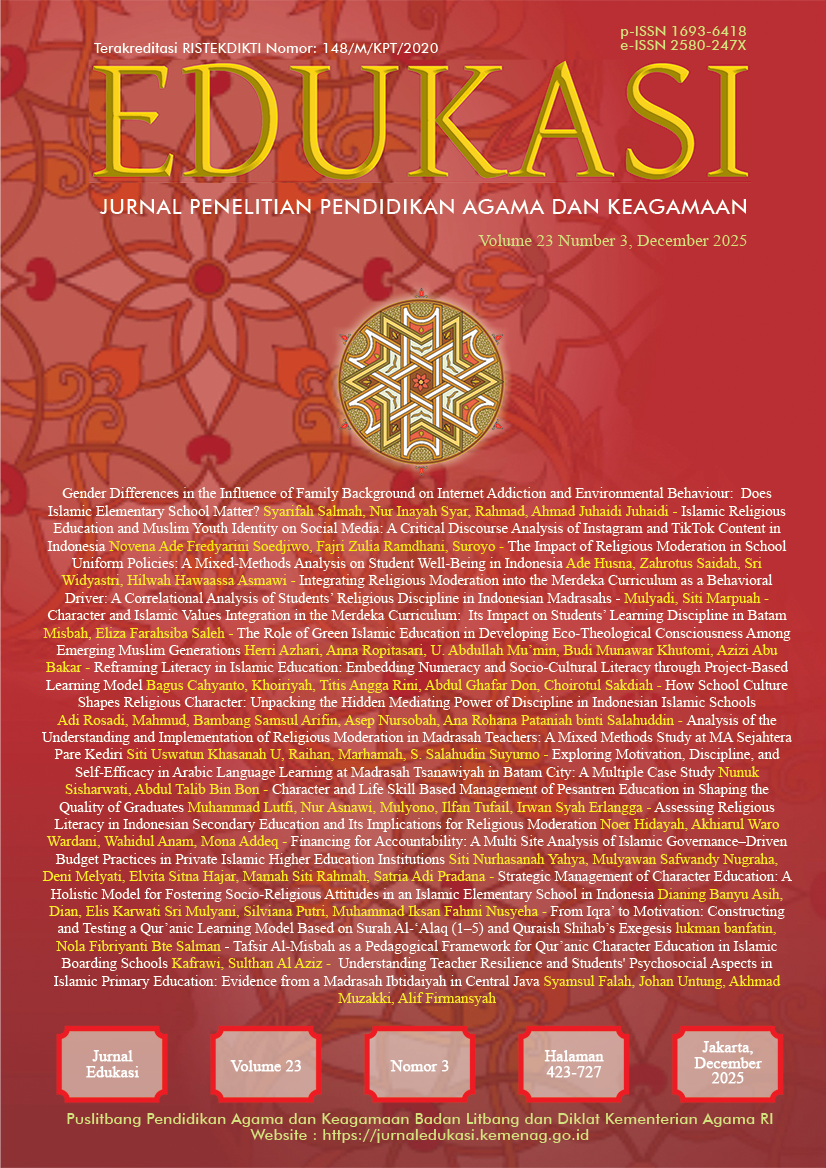
Strategic Management of Character Education: A Holistic Model for Fostering Socio-Religious Attitudes in an Islamic Elementary School in Indonesia
DOI:
https://doi.org/10.32729/edukasi.v23i3.2264Keywords:
Character Education, Strategic Management, Islamic School Management, Collaborative Evaluation, Socio-religious AttitudesAbstract
The decline in moral values and religious internalization among elementary school students necessitates effective character education management. This study aims to describe the strategic management of character education in shaping students' socio-religious attitudes at SD Assalam Bandung, an Islamic elementary school in Indonesia. Using a qualitative case study approach, data were collected through observation, in-depth interviews, and document analysis. The results reveal a three-phase strategic management model: (1) strategic formulation through a vision-based "Keassalaman Curriculum" integrating religious and social values; (2) implementation through systematic habituation, teacher exemplarity, and student leadership programs (Askar and Dakwah); and (3) evaluation via collaborative monitoring involving parents through the PPNP system. This integrated approach significantly improves students' social confidence and religious discipline. The study's novelty lies in applying strategic management as a holistic system in character education, addressing a gap in prior research that has focused narrowly on curriculum or pedagogy without examining integrative management processes. It offers a replicable model for Islamic elementary schools, contributing both conceptually and practically to systematic character education development.
ABSTRAK
Menurunnya nilai moral dan internalisasi religius pada siswa sekolah dasar memerlukan manajemen pendidikan karakter yang efektif. Penelitian ini bertujuan untuk mendeskripsikan manajemen strategis pendidikan karakter dalam membentuk sikap sosial-religius siswa di SD Assalam Bandung, sebuah sekolah dasar Islam di Indonesia. Menggunakan pendekatan studi kasus kualitatif, data dikumpulkan melalui observasi, wawancara mendalam, dan analisis dokumen. Hasil penelitian mengungkap model manajemen strategis tiga fase: (1) formulasi strategis melalui "Kurikulum Keassalaman" berbasis visi yang mengintegrasikan nilai religius dan sosial; (2) implementasi melalui pembiasaan sistematis, keteladanan guru, dan program kepemimpinan siswa (Askar dan Dakwah); dan (3) evaluasi melalui pemantauan kolaboratif yang melibatkan orang tua melalui sistem PPNP. Pendekatan terpadu ini secara signifikan meningkatkan kepercayaan diri sosial dan disiplin religius siswa. Kebaruan penelitian terletak pada penerapan manajemen strategis sebagai sistem holistik dalam pendidikan karakter, mengatasi celah penelitian sebelumnya yang hanya berfokus pada kurikulum atau pedagogi tanpa mengkaji proses manajemen yang terintegrasi. Studi ini menawarkan model yang dapat direplikasi untuk sekolah dasar Islam, berkontribusi baik secara konseptual maupun praktis bagi pengembangan pendidikan karakter yang sistematis.
Downloads
References
Aini, F. Q., Hasibuan, R. Y. A., & Gusmaneli, G. (2024). Pendidikan Karakter Sebagai Landasan Pembentukan Generasi Muda. Dewantara : Jurnal Pendidikan Sosial Humaniora, 3(4), 54–69. https://doi.org/10.30640/dewantara.v3i4.3321
Amin, Y., Marhumah, M., & Karwadi, K. (2025). Creative Education as An Innovation In Islamic Boarding Schools. EDUKASI: Jurnal Penelitian Pendidikan Agama Dan Keagamaan, 23(1), 131–147. https://doi.org/10.32729/edukasi.v23i1.1966
Andrianor, A., Sari, R. M., & Adhitya, A. (2024). Institutionalizing Science Integration at UIN Sunan Kalijaga: Insights from Students’ Perspectives. EDUKASI: Jurnal Penelitian Pendidikan Agama Dan Keagamaan, 22(3), 368–386. https://doi.org/10.32729/edukasi.v22i3.1919
Arifianto, A., & Wafa, A. (2025). The Strategic Role of Madrasah Committee in Strengthening Collective Leadership: Case Study of MA Tahfidz Alquran Pesanggaran Banyuwangi. EDUKASI: Jurnal Penelitian Pendidikan Agama Dan Keagamaan, 23(1), 119–130. https://doi.org/10.32729/edukasi.v23i1.2192
Berkowitz, M. W. (2011). What works in values education. International Journal of Educational Research, 50(3), 153–158. https://doi.org/10.1016/j.ijer.2011.07.003
Berkowitz, M. W., & Bier, M. C. (2004). Research-Based Character Education. The ANNALS of the American Academy of Political and Social Science, 591(1), 72–85. https://doi.org/10.1177/0002716203260082
Bryson, J. M. (2015). Strategic Planning for Public and Nonprofit Organizations. In International Encyclopedia of the Social & Behavioral Sciences (pp. 515–521). Elsevier. https://doi.org/10.1016/B978-0-08-097086-8.74043-8
Creswell, J. W., & Poth, C. N. (2018). Qualitative Inquiry and Research Design: Choosing Among Five Approaches (4th ed.). SAGE Publications.
Davies, B., & Davies, B. (2011). Talent Management in Education. SAGE Publications Ltd. https://doi.org/10.4135/9781446250907
Dilger, H. (2017). Embodying values and socio-religious difference: New markets of moral learning in Christian and Muslim schools in urban Tanzania. Africa, 87(3), 513–536. https://doi.org/10.1017/S0001972017000092
Epstein, J. L. (2018). School, Family, and Community Partnerships: Preparing Educators and Improving Schools (2nd ed.). Routledge. https://doi.org/10.4324/9780429494673
Firmansyah, M., Hilmi Ridho, Aizat Khairi, Sobriyah, S., & Rahwan, R. (2025). When Traditional Meets Modern Pedagogies: A Case Study of Ma`had Aly Situbondo. EDUKASI: Jurnal Penelitian Pendidikan Agama Dan Keagamaan, 23(1), 192–207. https://doi.org/10.32729/edukasi.v23i1.2143
Flick, U. (2022). An introduction to qualitative research.
Fullan, M. (2016). The new meaning of educational change. Teachers college press.
Halstead, M. (2004). An Islamic concept of education. Comparative Education, 40(4), 517–529. https://doi.org/10.1080/0305006042000284510
Hargreaves, A., & Fullan, M. (2015). Professional capital: Transforming teaching in every school. Teachers College Press.
Haris, A., Mardani, D. A., Kusnandar, E., & Mas’ad, M. A. (2024). Strengthening Religious Moderation through the Merdeka Curriculum: The Role of Islamic Religious Education Teachers at Public Senior High School. EDUKASI: Jurnal Penelitian Pendidikan Agama Dan Keagamaan, 22(3), 423–438. https://doi.org/10.32729/edukasi.v22i3.1958
Henderson, A. T., & Mapp, K. L. (2002). A new wave of evidence: The impact of school; family;, and community connections on Student achievement. National Center for family & community connections with schools.
Jeynes, W. H. (2019). A Meta-Analysis on the Relationship Between Character Education and Student Achievement and Behavioral Outcomes. Education and Urban Society, 51(1), 33–71. https://doi.org/10.1177/0013124517747681
Kautsar, E. S., Sohrah, Alwiyah, U., & Jabbar, A. (2025). The Practice of Qur’anic and Tafsir Integration in Thesis Writing: Challenges and Patterns at Biology Education Department UIN Alauddin Makassar. EDUKASI: Jurnal Penelitian Pendidikan Agama Dan Keagamaan, 23(1), 148–169. https://doi.org/10.32729/edukasi.v23i1.1942
Kristjánsson, K. (2015). Aristotelian character education. Routledge.
Leithwood, K., Harris, A., & Hopkins, D. (2020). Seven strong claims about successful school leadership revisited. School Leadership & Management, 40(1), 5–22. https://doi.org/10.1080/13632434.2019.1596077
Lickona, T. (2009). Educating for Character: How Our Schools Can Teach Respect and Responsibility. Random House Publishing Group.
Lincoln, Y. S. (1985). Naturalistic inquiry (Vol. 75). sage.
Lipiäinen, T., Ubani, M., Viinikka, K., & Kallioniemi, A. (2020). What does “new learning” require from religious education teachers? A study of Finnish RE teachers’ perceptions. Journal of Religious Education, 68(2), 213–231. https://doi.org/10.1007/s40839-020-00098-3
Malawi, I. (2016). Implementasi Pendidikan Karakter Melalui Pembelajaran Dalam Mata Pelajaran Di Sekolah Dasar. Premiere Educandum : Jurnal Pendidikan Dasar Dan Pembelajaran, 3(01). https://doi.org/10.25273/pe.v3i01.55
Maryani, M., Inayah, R., & Raharja, R. M. (2024). Pendidikan karakter sebagai strategi dalam pencegahan perilaku bullying di SMP. 1(1), 193–204.
Miles, M. B., Huberman, A. M., & Saldana, J. (2014). Qualitative data analysis: A methods sourcebook. (No Title).
Muhammad, R., & Mualimin, M. (2024). Students’ Perception and Social Acceptance towards Lecturers with Diffability (Different Ability). EDUKASI: Jurnal Penelitian Pendidikan Agama Dan Keagamaan, 22(3), 356–386. https://doi.org/10.32729/edukasi.v22i3.1872
Nucci, L., & Ilten-Gee, R. (2021). Moral education for social justice. Teachers College Press.
Parker, L., & Raihani, R. (2011a). Democratizing Indonesia through Education? Community Participation in Islamic Schooling. Educational Management Administration & Leadership, 39(6), 712–732. https://doi.org/10.1177/1741143211416389
Parker, L., & Raihani, R. (2011b). Democratizing Indonesia through Education? Community Participation in Islamic Schooling. Educational Management Administration & Leadership, 39(6), 712–732. https://doi.org/10.1177/1741143211416389
Patton, M. Q. (2015). Qualitative research & evaluation methods: Integrating theory and practice. (No Title).
Priatin, D. O. E., & Humairoh, H. (2023). Kupas Tuntas Teori Whelen Dan Hunger Dengan Metode Kualitatif. MANTRA (Jurnal Manajemen Strategis), 1(1), 17–25.
Sahin, A. (2018). Critical Issues in Islamic Education Studies: Rethinking Islamic and Western Liberal Secular Values of Education. Religions, 9(11), 335. https://doi.org/10.3390/rel9110335
Stoller, F. L. (2004). 12. Content-Based Instruction: Perspectives On Curriculum Planning. Annual Review of Applied Linguistics, 24, 261–283. https://doi.org/10.1017/S0267190504000108
Sutarto, S., Dewi Purnama Sari, Yanto, M., & Desfitranita, D. (2025). Need Analysis of Doctoral Students for Academic Services to Support Timely Completion of Studies of Islamic Religious Education at the Postgraduate Program of IAIN Curup. EDUKASI: Jurnal Penelitian Pendidikan Agama Dan Keagamaan, 23(1), 170–191. https://doi.org/10.32729/edukasi.v23i1.1935
Svensson, L., & Wihlborg, M. (2010). Internationalising the content of higher education: The need for a curriculum perspective. Higher Education, 60(6), 595–613. https://doi.org/10.1007/s10734-010-9318-6
Thanissaro, P. N. (2010). Finding a moral homeground: Appropriately critical religious education and transmission of spiritual values. International Journal of Children’s Spirituality, 15(2), 175–187. https://doi.org/10.1080/1364436X.2010.502223
Tisdell, E. J., Merriam, S. B., & Stuckey-Peyrot, H. L. (2025). Qualitative research: A guide to design and implementation. John Wiley & Sons.
Walker, D. I., Roberts, M. P., & Kristjánsson, K. (2015). Towards a new era of character education in theory and in practice. Educational Review, 67(1), 79–96. https://doi.org/10.1080/00131911.2013.827631
Willis, L., Shaukat, S., & Low‐Choy, S. (2022). Preservice teacher perceptions of preparedness for teaching: Insights from survey research exploring the links between teacher professional standards and agency. British Educational Research Journal, 48(2), 228–252. https://doi.org/10.1002/berj.3761
Yin, R. K. (2018). Case Study Research and Applications: Design and Methods (6th ed.). SAGE Publications.
Yugo, T., Yunani, A., & Salsabila, N. (2024). The Effect of Madrasah Diniyah Takmiliyah Awaliyah Learning on the Understanding of Islamic Education Subject in Elementary School. EDUKASI: Jurnal Penelitian Pendidikan Agama Dan Keagamaan, 22(3), 339–355. https://doi.org/10.32729/edukasi.v22i3.1829
Downloads
Published
Issue
Section
License
Copyright (c) 2025 Dian, Dianing Banyu Asih, Elis Karwati Sri Mulyani, Silviana Putri, Muhammad Iksan Fahmi Nusyeha, Nadira Salsabila

This work is licensed under a Creative Commons Attribution-ShareAlike 4.0 International License.